Must-Have Safety Equipment for Boating: A Complete Checklist for Every Vessel
Why Boating Safety Equipment Is Non-Negotiable
Every time you leave the dock, you accept a degree of risk that land-based activities simply don't carry. Weather changes without warning, engines fail, and collisions happen — often faster than anyone expects. The U.S. Coast Guard (USCG) mandates specific safety equipment for all recreational vessels, and these requirements exist because the data consistently shows that the right gear saves lives.
Beyond the legal dimension, there's a practical one. Rescue response times on open water are measured in hours, not minutes. That gap between an emergency and outside help arriving is exactly the window your onboard safety gear is designed to fill. Skipping it isn't just illegal — it's a gamble with your life and the lives of everyone aboard.
Whether you're refreshing the safety setup on a vessel you've owned for years or outfitting a new boat for the first time, this checklist covers everything from legally required items to strongly recommended extras that experienced mariners rarely leave port without.
Personal Flotation Devices (PFDs) — Your First Line of Defense
Personal Flotation Devices are the single most important piece of safety equipment on any boat. Federal law requires one USCG-approved wearable PFD for every person on board, and vessels 16 feet or longer must also carry at least one throwable Type IV device.
PFDs come in several types, each suited to different conditions and vessel types:
- Type I (Offshore Life Jacket): Maximum buoyancy, designed to turn an unconscious person face-up. Best for open, rough, or remote waters where rescue may be delayed.
- Type II (Near-Shore Buoyant Vest): Works in calm, inland waters where rescue is likely to be quick. Less bulky than Type I but offers less protection in rough conditions.
- Type III (Flotation Aid): The most common choice for recreational boating — comfortable to wear, suited for conscious users in calm water. Does not turn an unconscious person face-up.
- Type V (Special Use Device): Includes inflatable PFDs and hybrid models. Often the most comfortable option, but must be worn to count toward your legal requirement and maintained regularly.
Fit matters as much as type. A life jacket that's too loose can slip over a person's head in the water. Check that each PFD fits its assigned wearer snugly, and replace any that show signs of waterlogging, torn seams, or faded materials. Children require properly sized PFDs — an adult vest will not keep a child's head above water.
Fire Extinguishers and Visual Distress Signals
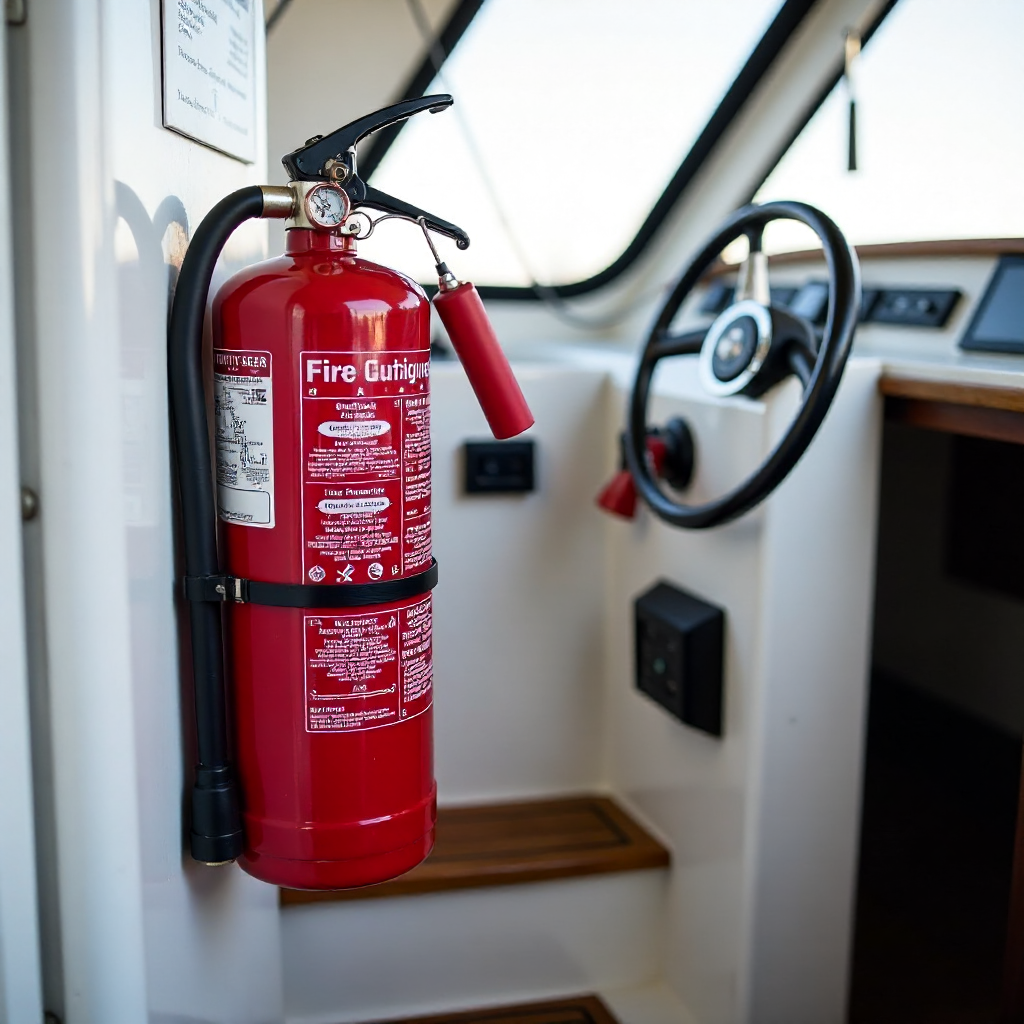
A marine-rated fire extinguisher is required on any motorized recreational vessel with enclosed spaces, fuel tanks, or built-in fuel systems. The USCG requires B-I or B-II rated extinguishers depending on vessel length, and these must be Coast Guard-approved, mounted in an accessible location, and in serviceable condition.
Boat fires spread quickly because of the confined space and proximity to fuel. Keep your extinguisher within arm's reach of the helm, not buried in a storage compartment. Check the pressure gauge monthly — a needle in the green zone indicates it's charged. Most dry chemical extinguishers should be replaced or professionally inspected every 6 years.
Visual distress signals are required on all vessels operating on coastal waters, the Great Lakes, and certain other navigable waters. Acceptable options include:
- USCG-approved pyrotechnic flares (handheld, parachute, or meteor)
- Non-pyrotechnic alternatives like an orange distress flag (daytime) and an electric SOS light (nighttime)
- A signal mirror, which is a low-tech but effective supplement in daylight
Flares have expiration dates — typically 42 months from manufacture — and expired flares do not satisfy legal requirements. Keep a log of your flare expiration dates and rotate them before they lapse. Many local Coast Guard stations or marine retailers accept expired flares for safe disposal.
Communication and Navigation Essentials
A VHF marine radio is the most reliable communication tool on the water, and no serious boater should leave without one. While not legally required on recreational vessels under 65 feet in U.S. waters, a VHF radio is strongly recommended by the USCG and considered essential by most experienced mariners.
Channel 16 is the international hailing and distress frequency — monitored continuously by the Coast Guard and most commercial vessels. In an emergency, a VHF radio lets you transmit a Mayday call with your position and situation to anyone within range, which typically spans 5 to 25 miles depending on terrain and antenna height. A handheld waterproof unit serves as a solid backup if your fixed-mount radio fails.
Navigation lights are legally required for any vessel operated between sunset and sunrise or in periods of restricted visibility. The specific light configuration depends on vessel type and length, but all motorized recreational boats must display red (port), green (starboard), and white (stern or masthead) lights. Failure to show proper navigation lights is a leading cause of nighttime collisions. Test your lights before every evening departure and carry spare bulbs or LED replacements.
For route planning and situational awareness, a GPS chartplotter or even a downloaded nautical chart app on a waterproof phone case significantly reduces the risk of grounding in unfamiliar waters. These aren't legally mandated, but they're the kind of gear that earns its place on every trip.
Throwable Devices, Sound Signals, and Anchoring Gear
A throwable flotation device — classified as a Type IV PFD — is required on all vessels 16 feet or longer. Unlike wearable life jackets, a Type IV is designed to be thrown to a person already in the water. Ring buoys and horseshoe buoys are the most common forms, and they must be immediately accessible, not stored in a locked compartment or buried under gear.
Sound-producing devices are required by both USCG regulations and international collision regulations (COLREGs). A horn or whistle is mandatory for vessels operating in or near other traffic. The specific requirement depends on vessel length:
- Vessels under 39.4 feet: any sound-producing device (a simple pealess whistle qualifies)
- Vessels 39.4 feet and over: a power whistle or horn audible for at least half a mile
An anchor and adequate line round out this category. An anchor isn't legally required in most jurisdictions, but it's one of the most useful pieces of safety gear you can carry. A dragging boat, a stalled engine near a lee shore, or a medical situation requiring you to hold position — in all of these scenarios, an anchor buys you time. Match anchor type and weight to your vessel size and the bottom conditions in your typical boating area.
First Aid Kits and Bilge Pumps — Practical Onboard Essentials
A marine first aid kit belongs on every vessel, regardless of trip length. Standard kits should include wound care supplies, burn dressings, seasickness medication, waterproof bandages, CPR face shield, and any prescription medications for people on board. Pre-packaged marine kits are available in various sizes, but review the contents and supplement based on your crew's specific needs.
Water ingress is an ever-present risk on any boat. A bilge pump — either electric or manual — is required on many vessel types and is considered essential on all of them. Electric bilge pumps are convenient but depend on battery power. A manual bailer or hand pump provides a critical backup if your electrical system fails. Check that your bilge pump float switch activates correctly before each trip and keep the bilge area clear of debris that could clog the intake.
How to Store, Inspect, and Maintain Your Safety Equipment
Safety gear only works if it's accessible, functional, and in date. The most common failure point isn't the equipment itself — it's poor organization and deferred maintenance.
Build a simple inspection routine into your pre-departure checklist:
- Verify all PFDs are present, correctly sized, and free of damage
- Check fire extinguisher pressure gauge and mounting bracket
- Confirm flares are within their expiration date
- Test navigation lights and VHF radio
- Confirm the throwable device is unobstructed and accessible
- Check bilge pump operation and battery level
Storage location matters. PFDs should be within reach of every seating area, not buried in a bow locker. The throwable device should be mounted near the helm or cockpit. Fire extinguishers need to be visible and unobstructed. Flares should be stored in a waterproof container at a consistent, known location.
At the start of each season, do a full audit. Replace expired flares, recharge or replace fire extinguishers as needed, inspect inflatable PFD cylinders and arming mechanisms, and test every electronic device. The U.S. Coast Guard offers free vessel safety checks through its Auxiliary program — a useful annual resource for confirming your setup meets current standards.
Frequently Asked Questions
What safety equipment is legally required on a boat?
At minimum, USCG regulations require wearable PFDs for every person on board, a throwable Type IV PFD on vessels 16 feet or longer, a fire extinguisher on motorized vessels with enclosed spaces, visual distress signals on coastal waters, navigation lights for nighttime operation, and a sound-producing device. Requirements vary by vessel length and operating area, so always verify with your local authority.
How many life jackets do I need on my boat?
You need at least one USCG-approved wearable PFD for every person on board. Vessels 16 feet and longer must also carry one Type IV throwable device in addition to the wearable PFDs.
Do flares expire, and how do I dispose of them?
Yes. Pyrotechnic flares expire 42 months from their manufacture date. Expired flares don't meet legal requirements. For disposal, contact your local Coast Guard station, marina, or hazardous materials facility — many accept expired marine flares at no charge.
What is the difference between a Type I, II, III, and IV PFD?
Type I offers the highest buoyancy and is designed for offshore, rough-water use. Type II works in calmer, near-shore conditions. Type III is the most comfortable for active recreational use in calm water. Type IV is a throwable device — not worn, but thrown to someone already in the water. Each type has specific intended use cases, and choosing the right one depends on where and how you boat.
Is a VHF radio required by law on recreational boats?
In U.S. waters, a VHF marine radio is not legally required on recreational vessels under 65 feet. However, it is strongly recommended by the USCG and considered essential safety equipment. In an emergency, it's your most reliable way to call for help and communicate your position to rescue services.